Ferric Chloride for COD and TSS Removal in Wastewater

Ferric Chloride for COD and TSS Removal in Wastewater
Effective wastewater treatment is essential for industrial facilities seeking to maintain water quality, comply with environmental regulations, and improve operational efficiency. Among the chemicals commonly used in industrial wastewater treatment, Ferric Chloride is widely recognized for its ability to support coagulation, flocculation, and the removal of suspended contaminants.
Ferric Chloride for COD and TSS Removal is an effective treatment approach for wastewater containing suspended solids, colloidal particles, and certain organic pollutants. By promoting particle aggregation and sedimentation, Ferric Chloride can help improve wastewater clarity and reduce pollutant concentrations before discharge or further treatment.
Understanding how Ferric Chloride works, its benefits, and the factors affecting its performance can help industrial operators select suitable Wastewater Treatment Chemicals for their treatment systems.
1.Understanding COD and TSS in Industrial Wastewater
Before exploring how Ferric Chloride works, it is important to understand two key wastewater quality indicators: Chemical Oxygen Demand (COD) and Total Suspended Solids (TSS).
What Is COD?
Chemical Oxygen Demand (COD) measures the amount of oxygen required to chemically oxidize organic and other oxidizable substances in water. A high COD level generally indicates a significant concentration of pollutants that may affect receiving water quality.
Industrial wastewater from food processing, textile manufacturing, chemical production, and other manufacturing operations may contain organic compounds that contribute to elevated COD levels.
What Is TSS?
Total Suspended Solids (TSS) refers to solid particles suspended in water that cannot readily dissolve. These particles may include dirt, fibers, sludge, fine sediments, and other suspended materials.
High TSS concentrations can make wastewater cloudy, increase sludge accumulation, and reduce the efficiency of downstream treatment processes.
Both COD and TSS are important parameters when evaluating wastewater treatment performance. An appropriate chemical treatment process can help reduce these pollutants and improve overall system efficiency.
2.How Does Ferric Chloride Work in Wastewater Treatment?
Ferric Chloride for Wastewater Treatment is commonly used as an inorganic coagulant. When added to wastewater, Ferric Chloride dissolves and reacts with water, producing iron hydroxide species that help destabilize suspended and colloidal particles.
The treatment process generally involves two main stages:
Coagulation
During coagulation, Ferric Chloride helps neutralize the electrical charges surrounding fine particles in wastewater. These particles normally repel one another and remain dispersed in water.
By reducing this repulsion, Ferric Chloride allows smaller particles to come together and form larger aggregates.
Flocculation
Following coagulation, gentle mixing encourages the destabilized particles to combine into larger flocs. These flocs can then be separated through sedimentation, clarification, or filtration.
The resulting process helps remove suspended contaminants and improve the clarity of treated water.
3.How Ferric Chloride Helps Reduce TSS
One of the key advantages of Ferric Chloride is its ability to support Ferric Chloride TSS Removal through coagulation and flocculation.
Fine suspended particles are often difficult to remove through sedimentation alone because they remain dispersed in wastewater. Ferric Chloride helps bring these particles together into larger flocs, making them easier to separate.
The main benefits include:
- Improved particle aggregation: Helps combine fine suspended solids into larger flocs.
- Enhanced sedimentation: Larger flocs generally settle more readily than individual fine particles.
- Improved water clarity: Reduces visible turbidity and suspended contaminants.
- Better solids separation: Supports clarification and filtration processes.
The actual TSS reduction depends on wastewater characteristics, chemical dosage, pH, mixing conditions, and the efficiency of the separation equipment.
4.How Ferric Chloride Supports COD Reduction
Ferric Chloride COD Removal works primarily by helping remove organic matter associated with suspended and colloidal particles.
Some organic pollutants are attached to fine solids or exist as colloidal materials. When Ferric Chloride promotes coagulation and flocculation, these contaminants can become incorporated into the resulting flocs and be removed during sedimentation or filtration.
This process can contribute to lower COD concentrations in treated wastewater.
However, it is important to understand that Ferric Chloride does not remove every type of organic compound equally. Dissolved organic substances that remain in the water may not be effectively removed by coagulation alone.
For wastewater containing significant amounts of dissolved organic pollutants, additional treatment processes may be required, such as biological treatment, activated carbon adsorption, or advanced oxidation, depending on the wastewater composition.
Therefore, COD and TSS Removal from Wastewater should be evaluated together with the overall treatment objectives and the characteristics of the wastewater.
5.Key Factors Affecting Ferric Chloride Performance
To achieve effective treatment results, industrial facilities should consider several operating factors.
pH of Wastewater
pH affects Ferric Chloride hydrolysis, iron hydroxide formation, and coagulation performance. The optimum pH varies depending on wastewater composition and treatment objectives.
Regular monitoring and adjustment may be necessary to maintain suitable operating conditions.
Chemical Dosage
The appropriate Ferric Chloride dosage depends on the initial COD and TSS concentrations, particle characteristics, alkalinity, and other water quality parameters.
Insufficient dosage may result in incomplete coagulation, while excessive dosage can increase chemical consumption, sludge production, and potentially affect treated water pH.
Mixing Conditions
Rapid mixing helps distribute Ferric Chloride throughout the wastewater, while slower mixing encourages floc formation.
Incorrect mixing conditions may reduce floc size and negatively affect separation efficiency.
Wastewater Characteristics
Different industrial processes generate wastewater with different pollutant profiles. A treatment approach that works well for one facility may not produce the same results at another.
For this reason, treatment conditions should be evaluated using actual wastewater samples.
6.Why Jar Testing Is Important Before Using Ferric Chloride
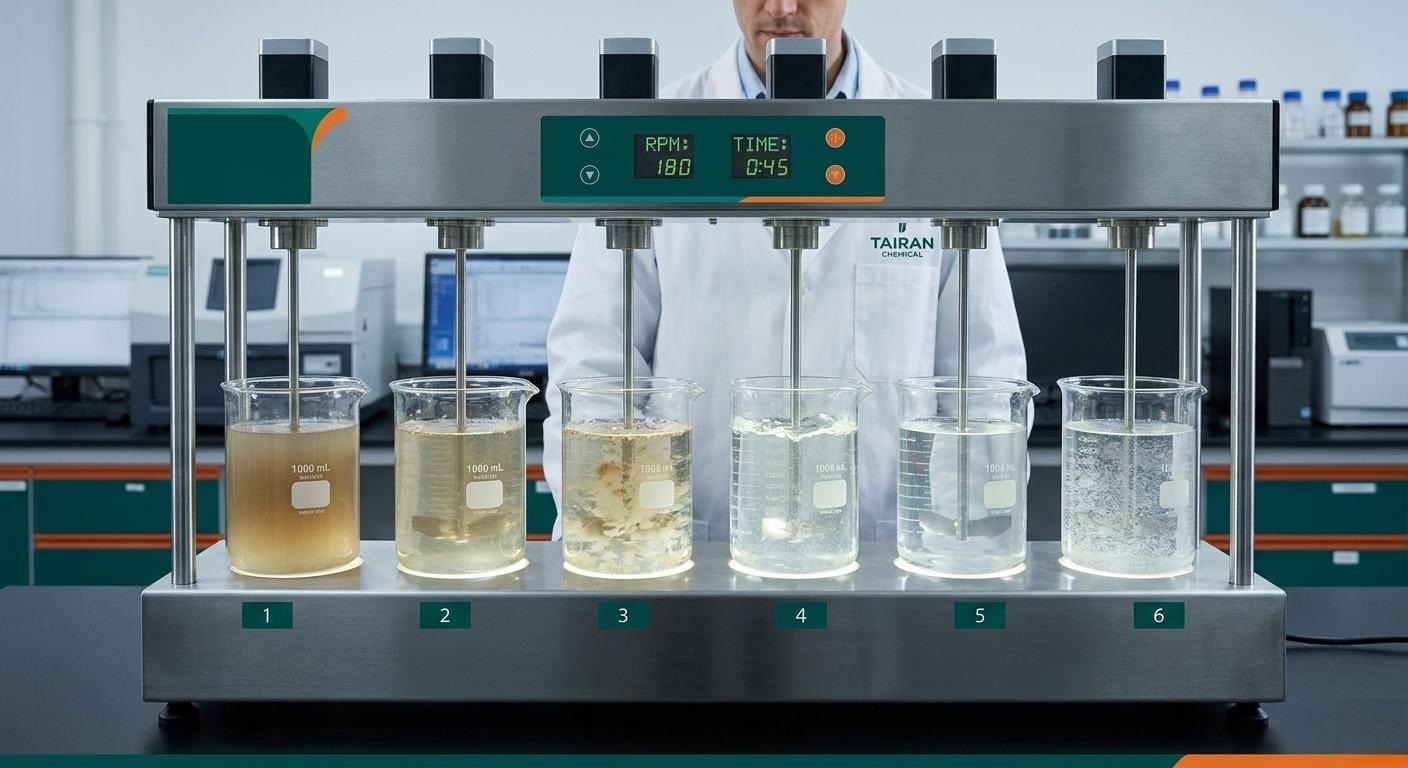
A Jar Test is a laboratory-scale evaluation used to determine suitable coagulant dosage and operating conditions before full-scale application.
During a Jar Test, different Ferric Chloride dosages are added to wastewater samples under controlled mixing conditions. The resulting floc formation, settling behavior, and water clarity are then evaluated.
Depending on the treatment objectives, the test may also include measurements of COD, TSS, turbidity, and pH before and after treatment.
Jar Testing helps industrial operators:
- Identify an appropriate Ferric Chloride dosage.
- Evaluate coagulation and flocculation performance.
- Determine suitable pH and mixing conditions.
- Estimate sludge generation.
- Reduce unnecessary chemical consumption.
- Improve treatment consistency and operational efficiency.
Conducting a Jar Test is an important step in developing an effective chemical treatment program.
7.Industrial Applications of Ferric Chloride
Ferric Chloride is used in various industrial wastewater treatment applications where coagulation and solids separation are required.
Common applications include:
- Food and beverage manufacturing: Helps remove suspended organic materials from process wastewater.
- Textile and dyeing industries: Supports the removal of color-associated particles and suspended contaminants.
- Chemical manufacturing: Helps separate suspended solids and certain coagulated contaminants.
- Metal processing: Supports wastewater clarification and the removal of particulate matter.
- General manufacturing: Can be incorporated into physicochemical treatment systems to improve solids separation.
The effectiveness of Ferric Chloride varies according to the type of wastewater and the contaminants present. Proper testing is recommended before selecting a full-scale treatment program.
8.Benefits of Choosing the Right Ferric Chloride Treatment Program
Selecting an appropriate Ferric Chloride treatment program can provide several operational benefits:
- Improved removal of suspended solids.
- Reduced COD associated with particulate and colloidal organic matter.
- Better clarification and downstream filtration performance.
- More controlled chemical consumption through dosage optimization.
- Support for wastewater quality management and environmental compliance.
For industrial facilities, the goal should not simply be to add more chemicals, but to establish a treatment process that delivers consistent results while balancing chemical costs, sludge management, and operational requirements.
Conclusion: Improving Wastewater Treatment with Ferric Chloride
Ferric Chloride is a valuable coagulant for industrial wastewater treatment, particularly when the wastewater contains suspended solids, colloidal particles, and organic matter associated with these particles.
Through coagulation and flocculation, Ferric Chloride helps improve COD and TSS Removal from Wastewater by promoting the formation of larger flocs that can be separated through sedimentation or filtration.
While its effectiveness depends on wastewater characteristics and operating conditions, proper dosage selection, pH control, mixing, and Jar Testing can help optimize treatment performance.
At UNCHING INDUSTRY CO., LTD., we recognize the importance of reliable chemical solutions for industrial water and wastewater management. Choosing suitable wastewater treatment chemicals and optimizing their application can help businesses improve operational efficiency and support more sustainable industrial practices.
Contact Unching Industry to learn more about Ferric Chloride and chemical solutions for your industrial wastewater treatment requirements.
Frequently Asked Questions (FAQs)
1.Can Ferric Chloride reduce both COD and TSS?
Yes. Ferric Chloride can help reduce TSS and COD associated with suspended or colloidal organic matter through coagulation and flocculation. Its effectiveness depends on wastewater characteristics.
2.How does Ferric Chloride remove suspended solids?
It destabilizes fine particles and promotes the formation of larger flocs, which can be removed through sedimentation or filtration.
3.Does Ferric Chloride remove dissolved organic matter?
Not effectively in every case. Dissolved organic compounds may require additional processes such as biological treatment, activated carbon adsorption, or advanced oxidation.
4.What factors affect Ferric Chloride performance?
Important factors include wastewater pH, chemical dosage, mixing conditions, alkalinity, pollutant concentrations, and separation efficiency.
5.Why is Jar Testing necessary?
Jar Testing helps determine the appropriate dosage and operating conditions based on actual wastewater samples before full-scale application.
6.Can Ferric Chloride be used in different industries?
Yes. It is used in wastewater treatment applications across food processing, textile, chemical, metal processing, and general manufacturing industries.
7.Does Ferric Chloride increase sludge production?
Ferric Chloride treatment generates iron-containing flocs that become part of the treatment sludge. Sludge quantity and characteristics depend on the wastewater and chemical dosage.
8.How can industries optimize Ferric Chloride consumption?
Industries can optimize consumption by conducting Jar Tests, monitoring pH and wastewater quality, adjusting dosage, and regularly evaluating treatment performance.