Types of Copper Sulfate: CuSO₄ and Pentahydrate
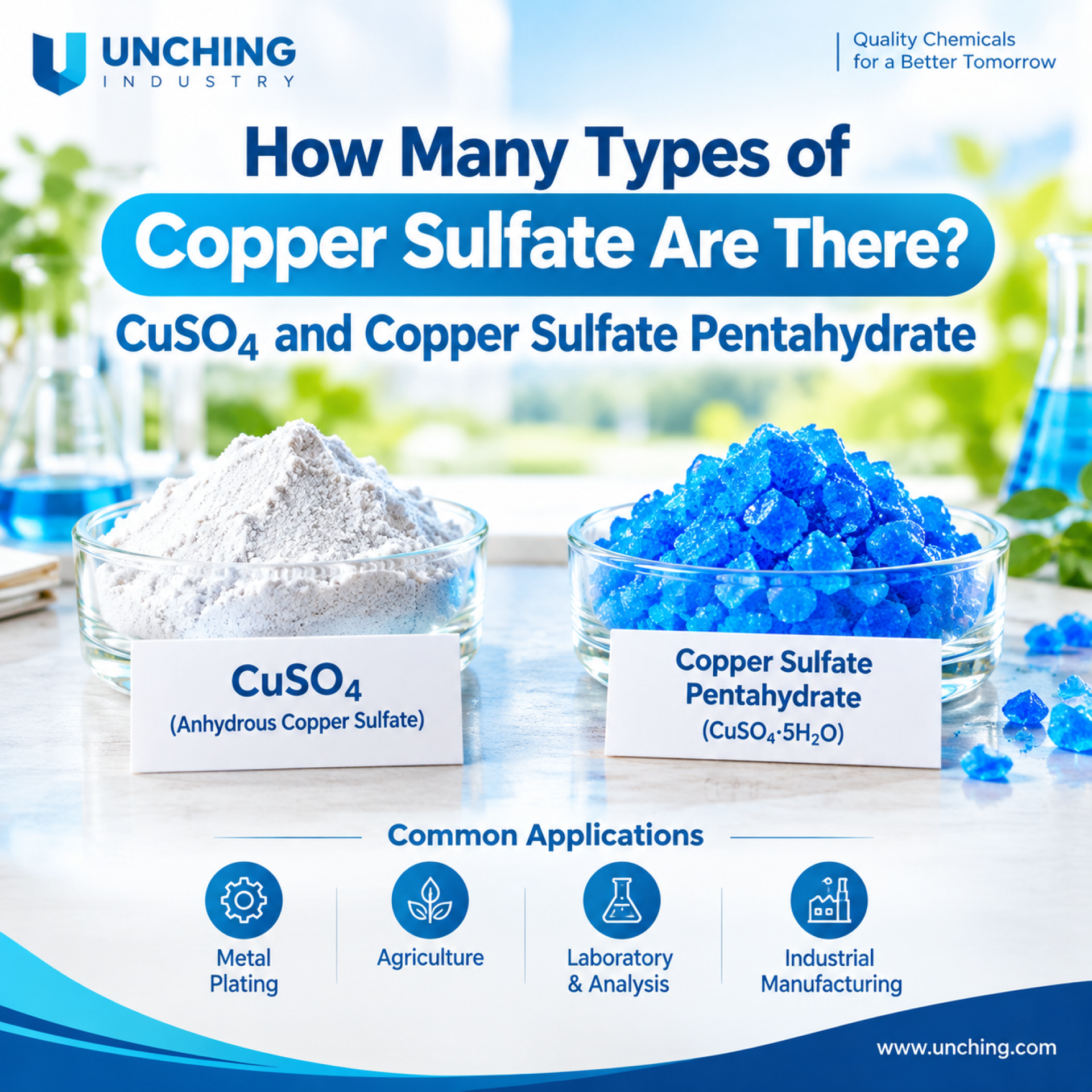
Types of Copper Sulfate: CuSO₄ and Copper Sulfate Pentahydrate
Understanding Copper Sulfate and Its Different Forms
Copper Sulfate is an important inorganic chemical compound used in various industrial, agricultural, and chemical processes. Its properties and applications depend on its chemical form, purity, and the specific requirements of each process. Understanding the different types of Copper Sulfate helps businesses select suitable products for their operational needs and quality standards.
The two commonly discussed forms are Anhydrous Copper Sulfate (CuSO₄) and Copper Sulfate Pentahydrate (CuSO₄·5H₂O). Although both contain copper and sulfate ions, they differ in their crystal water content, physical appearance, molar mass, and copper content by weight.
For industrial users, understanding these differences is essential for accurate chemical calculations, effective process control, and appropriate product selection. This article explores the types of Copper Sulfate, their key properties, common applications, and important considerations when choosing the right form for industrial use.
1.What Is Copper Sulfate?
Copper Sulfate, also known as copper(II) sulfate, is an inorganic compound consisting of copper and sulfate ions. Its chemical formula is commonly represented as CuSO₄, while its hydrated forms contain water molecules incorporated into their crystal structures.
Copper Sulfate is available in different forms, each offering characteristics suitable for specific applications. The most familiar commercial form is Copper Sulfate Pentahydrate, which typically appears as bright blue crystals. In contrast, Anhydrous Copper Sulfate is generally white to off-white when sufficiently pure.
Key characteristics of Copper Sulfate include:
- Chemical composition: Contains copper and sulfate ions.
- Different hydration states: Available in anhydrous and hydrated forms.
- Solubility: Both forms can dissolve in water, with behavior depending on temperature and solution conditions.
- Industrial versatility: Used in selected chemical processes, metal finishing, laboratory applications, and agricultural products.
- Product specifications: Purity, particle size, moisture content, and grade can influence suitability for different applications.
When selecting Copper Sulfate, businesses should review the Technical Data Sheet (TDS) and Safety Data Sheet (SDS) to confirm that the product meets the intended process requirements.
2.What Are the Main Types of Copper Sulfate?
Copper Sulfate can exist in several hydration states. For practical industrial discussions, two important forms are Anhydrous Copper Sulfate and Copper Sulfate Pentahydrate.
2.1 Anhydrous Copper Sulfate (CuSO₄)
Anhydrous Copper Sulfate has the chemical formula CuSO₄ and contains no water molecules within its crystal structure.
Key properties:
- Typically appears as a white or off-white powder when sufficiently pure.
- Can absorb water and undergo a change in hydration state.
- Changes in physical appearance may occur when it reacts with water.
- Has a higher copper content by weight than Copper Sulfate Pentahydrate, assuming both substances are pure.
Common applications
Anhydrous Copper Sulfate is used in selected laboratory procedures and chemical applications where a water-free form is required. It can also be used to demonstrate the presence of water through its characteristic color change upon hydration under suitable conditions.
For industrial procurement, buyers should confirm the required grade, purity, and moisture specifications before selecting this form.
2.2 Copper Sulfate Pentahydrate (CuSO₄·5H₂O)
Copper Sulfate Pentahydrate is a hydrated form of Copper Sulfate containing five water molecules within its crystal structure. Its chemical formula is CuSO₄·5H₂O.
This form is widely recognized by its distinctive blue crystalline appearance and is commonly available in commercial markets.
Key properties:
- Typically appears as bright blue crystals.
- Contains five water molecules per formula unit.
- Dissolves in water to form a copper-containing solution.
- Has a lower theoretical copper content by weight than the anhydrous form.
- Is available in different commercial grades depending on the intended application.
Common applications
Copper Sulfate Pentahydrate is used in selected metal-finishing processes, agricultural formulations, laboratory applications, and chemical manufacturing. Its suitability depends on product purity, process requirements, and applicable regulations.
Industrial buyers should verify the product specifications and intended use before incorporating it into a manufacturing process.
3.What Is the Difference Between CuSO₄ and Copper Sulfate Pentahydrate?
Although both substances are forms of Copper Sulfate, their differences in hydration state affect their molecular weight and copper concentration by weight.
| Property | Anhydrous Copper Sulfate | Copper Sulfate Pentahydrate |
| Chemical formula | CuSO₄ | CuSO₄·5H₂O |
| Crystal water | None | Five water molecules |
| Typical appearance | White to off-white powder | Blue crystals |
| Molar mass | Approximately 159.61 g/mol | Approximately 249.68 g/mol |
| Theoretical copper content | Approximately 39.8% | Approximately 25.5% |
| Typical uses | Laboratory and specialized chemical applications | Industrial processes, metal finishing, and agricultural formulations |
Note: Copper content percentages are theoretical values for pure compounds. Actual commercial product specifications may vary according to purity and moisture content.
One important consideration is that equal weights of these two forms do not provide equal amounts of copper. If a manufacturing process changes from one form to another, chemical dosage calculations may need to be adjusted according to the required copper content and product purity.
Understanding these differences helps industrial users improve chemical calculation accuracy, maintain consistent process conditions, and select products that meet their technical requirements.
4.Copper Sulfate Properties and Industrial Applications
Copper Sulfate properties make it useful in several industries. However, its suitability depends on the chemical form, product grade, and intended application.
4.1 Metal Finishing and Electroplating
Copper Sulfate is used as a source of copper ions in certain copper electroplating processes. In these applications, solution composition and operating conditions must be carefully controlled to achieve the required coating quality and process performance.
4.2 Agriculture
Copper Sulfate is used in certain agricultural products, including formulations intended to supply copper or manage specific plant diseases. Only products approved for the intended purpose should be used, following label instructions and applicable regulations.
4.3 Laboratory and Chemical Analysis
Different forms of Copper Sulfate are used in laboratory procedures and chemical demonstrations. Anhydrous Copper Sulfate, for example, can help indicate the presence of water through a characteristic color change under suitable conditions.
4.4 Industrial Chemical Manufacturing
Copper Sulfate may serve as a raw material or process chemical in selected manufacturing applications. Product purity, solubility, and compatibility with other process chemicals should be evaluated before use.
4.5 Water and Environmental Management
Copper-containing chemicals may be relevant to certain specialized treatment or analytical processes. However, Copper Sulfate should not be assumed to be a general-purpose wastewater treatment chemical. Its use must be based on a defined treatment objective, technical assessment, and environmental requirements.
Environmental and safety considerations: Copper Sulfate can be harmful if mishandled and is particularly hazardous to aquatic organisms. Appropriate personal protective equipment, safe storage, spill management, and compliant waste disposal are essential. Copper-containing wastewater must be managed according to applicable discharge requirements.
5. How to Choose the Right Copper Sulfate for Industrial Use
Selecting the appropriate Copper Sulfate product requires more than comparing appearance or price. Industrial buyers should evaluate several technical and operational factors.
5.1 Confirm the Required Chemical Form
Determine whether the process requires Anhydrous Copper Sulfate or Copper Sulfate Pentahydrate. Their different hydration states affect molar mass and copper content by weight, which can influence dosage calculations.
5.2 Check Product Purity and Grade
Review the purity, moisture content, and other relevant specifications. Industrial-grade products and laboratory-grade products may have different requirements and should not be substituted without confirming their suitability.
5.3 Evaluate Process Requirements
Consider solubility, required copper concentration, particle size, handling procedures, and compatibility with other chemicals used in the process.
5.4 Review Technical and Safety Documentation
Request the TDS and SDS from the supplier. These documents provide information about product specifications, safe handling, storage, transportation, and emergency procedures.
5.5 Select a Reliable Chemical Supplier
A professional chemical supplier should provide clear product specifications, appropriate documentation, and technical information to support purchasing decisions. These factors help businesses evaluate product suitability and maintain consistent operational standards.
For organizations sourcing industrial chemicals, a structured product evaluation process can support quality control, purchasing efficiency, and responsible chemical management.
6.Conclusion: Choosing the Right Type of Copper Sulfate
Understanding the different types of Copper Sulfate is essential for selecting the right chemical for industrial and specialized applications. Anhydrous Copper Sulfate (CuSO₄) contains no crystal water, while Copper Sulfate Pentahydrate (CuSO₄·5H₂O) contains five water molecules and typically appears as blue crystals.
These differences influence molar mass and theoretical copper content, making chemical form an important consideration in dosage calculations and process planning. Businesses should also evaluate product purity, technical specifications, safety requirements, and application suitability before making a purchasing decision.
Unching Industry supports industrial customers with chemical solutions and product information to help businesses evaluate their operational requirements and make informed chemical selection decisions.
For more information about industrial chemical products, contact Unching Industry to discuss your requirements and identify suitable product specifications for your application.