What Is a Jar Test? Choosing Wastewater Treatment Chemicals
What Is a Jar Test? Why Factories Should Test Before Choosing Wastewater Treatment Chemicals
Effective wastewater treatment begins with understanding wastewater characteristics and selecting the right chemicals for the application. For industrial facilities, choosing unsuitable chemicals or applying incorrect dosages can lead to poor treatment performance, excessive chemical consumption, and higher operating costs.
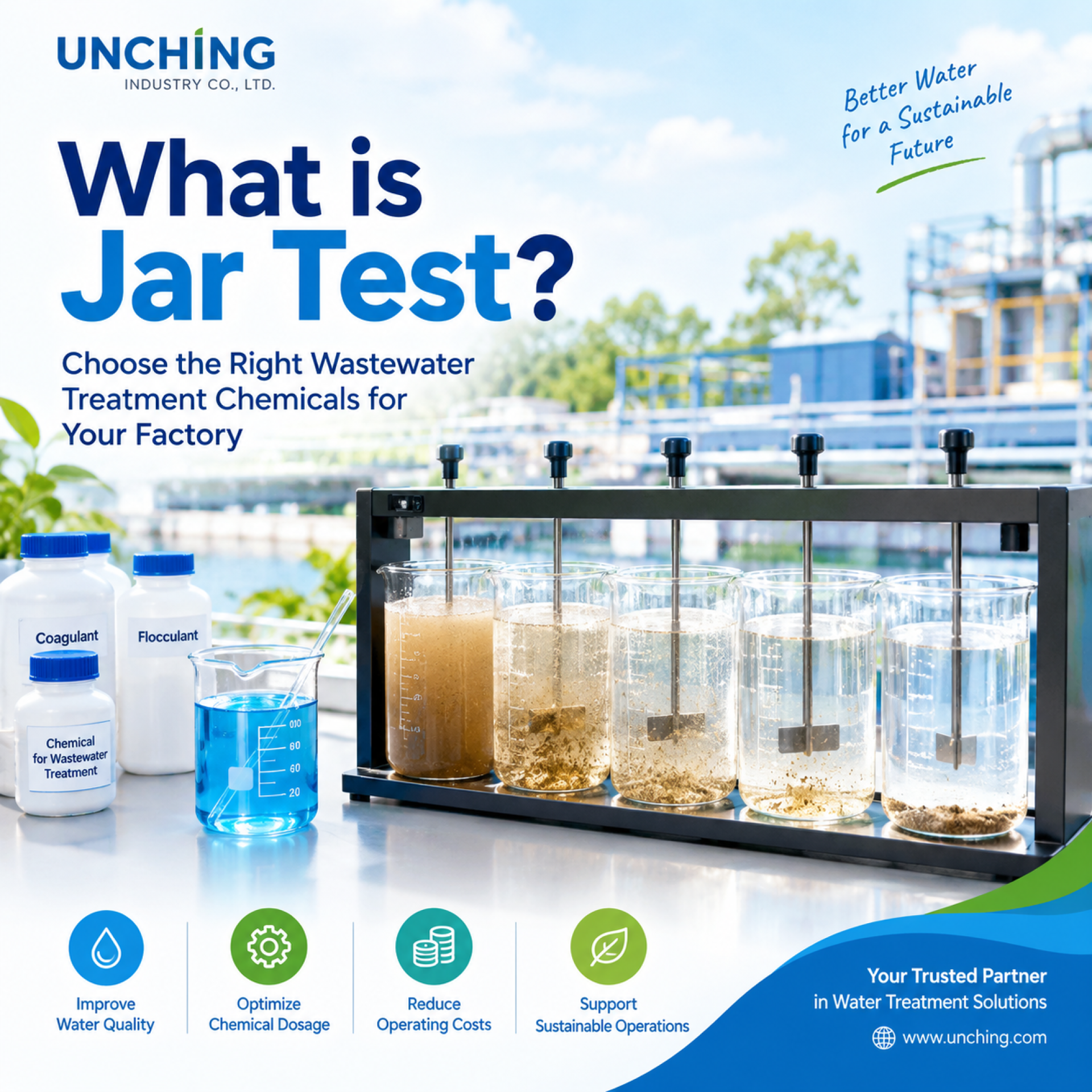
A Jar Test is a practical laboratory method that helps evaluate the effectiveness of different treatment chemicals under controlled conditions. By simulating coagulation, flocculation, and settling on a small scale, factories can compare chemical performance and identify suitable treatment conditions before making changes to their full-scale wastewater treatment systems.
For industries seeking reliable and cost-effective Wastewater Treatment Chemicals, jar testing provides valuable information to support better chemical selection, improve process efficiency, and promote consistent wastewater quality.
What Is a Jar Test?
A Jar Test is a laboratory procedure used to determine how wastewater responds to different treatment chemicals, dosages, and operating conditions. It is commonly applied to evaluate the removal of suspended solids, reduction of turbidity, and improvement of solid-liquid separation.
During the test, wastewater samples are placed in several beakers. Different chemicals or dosages are added, followed by controlled mixing and a settling period. The results are then compared to identify the most suitable treatment conditions.
In industrial wastewater treatment, jar testing is particularly useful for assessing coagulants and flocculants. These chemicals help fine particles combine into larger aggregates, making them easier to remove through sedimentation or other separation processes.
Rather than relying on assumptions, a Jar Test for Wastewater Treatment allows operators to assess chemical performance using representative wastewater samples.
Why Should Factories Conduct a Jar Test Before Choosing Chemicals?
Industrial wastewater varies depending on the manufacturing process, raw materials, production schedule, and cleaning operations. As a result, a chemical that works well for one wastewater stream may not deliver the same performance in another.
Conducting a Jar Test before selecting treatment chemicals offers several important advantages.
1.Identify Suitable Treatment Chemicals
Jar testing allows operators to compare different chemical products under similar conditions. This helps identify suitable coagulants and flocculants based on actual treatment performance rather than product specifications alone.
2. Determine an Appropriate Chemical Dosage
Too little chemical may result in insufficient contaminant removal, while excessive dosing can increase costs and may negatively affect treatment performance. A Jar Test helps establish a practical dosage range for further evaluation.
3. Improve Water Clarity and Solids Removal
By evaluating floc formation, settling behavior, and residual turbidity, operators can identify treatment conditions that improve the separation of suspended particles from wastewater.
4. Control Operating Costs
Selecting suitable chemicals and optimizing dosage can help reduce unnecessary chemical consumption. Factories should also consider supporting chemical requirements, sludge handling, and other operating expenses when comparing treatment options.
5. Support More Consistent Treatment Performance
Regular testing, particularly when wastewater characteristics change, helps operators reassess chemical performance and make informed adjustments to treatment conditions.
How Does a Jar Test Work?
A typical Jar Test involves several steps designed to simulate key stages of the wastewater treatment process.
Step 1: Collect a Representative Wastewater Sample
Collect a sample that reflects the wastewater being treated under actual operating conditions. If wastewater quality fluctuates, additional samples may be needed to assess variations.
Measure relevant parameters such as pH, turbidity, and suspended solids according to the treatment objectives.
Step 2: Prepare the Treatment Chemicals
Prepare the selected coagulants and flocculants according to the manufacturer's instructions. Follow the relevant Safety Data Sheet (SDS) for chemical handling, preparation, and personal protective equipment.
Step 3: Test Different Chemicals and Dosages
Divide the wastewater into several beakers and apply different products or dosages. Depending on the objective, testing may also include different pH conditions or combinations of treatment chemicals.
Keep other test conditions consistent wherever possible to make comparisons more meaningful.
Step 4: Apply Rapid and Slow Mixing
Rapid mixing helps distribute the coagulant throughout the sample and destabilize suspended particles. Slow mixing encourages the destabilized particles to combine into larger flocs, particularly when a suitable flocculant is added.
Step 5: Allow the Wastewater to Settle
After mixing, allow the samples to settle for a defined period. Observe floc size, settling speed, sludge characteristics, and the clarity of the treated water.
Step 6: Compare Results and Select Suitable Conditions
Compare the samples using relevant indicators, including residual turbidity, suspended solids, pH, settling performance, and chemical consumption.
The preferred condition should meet the treatment objectives while balancing chemical costs, sludge management, and compatibility with the existing system. Laboratory results should be validated before full-scale implementation.
How to Choose the Right Wastewater Treatment Chemicals
Selecting the right Wastewater Treatment Chemicals requires a clear understanding of the wastewater characteristics, treatment targets, and operating requirements.
Coagulant Selection
Coagulants help destabilize fine particles so they can aggregate and be separated from wastewater. Common options include aluminum-based and iron-based coagulants.
Effective Coagulant Selection should consider:
- Contaminant removal performance.
- Suitable pH range and adjustment requirements.
- Required dosage and total treatment cost.
- Sludge production and handling requirements.
- Compatibility with downstream treatment processes.
A Jar Test helps compare candidate coagulants under controlled conditions to determine which products are suitable for further evaluation.
Choosing the Right Flocculant
A Flocculant promotes the formation of larger flocs, which can improve settling or other solid-liquid separation processes.
During testing, evaluate floc size, settling behavior, water clarity, and the stability of the formed flocs. The appropriate product and dosage depend on the wastewater characteristics and the coagulant used.
Optimizing Coagulation and Flocculation
Coagulation and Flocculation are complementary processes. Coagulation destabilizes particles, while flocculation encourages them to form larger aggregates.
A Jar Test can help assess the sequence of chemical addition, mixing conditions, dosage, and settling time. Optimizing these factors can improve treatment performance and reduce unnecessary chemical use.
Chemical Dosing Optimization
Chemical Dosing Optimization involves identifying suitable dosage conditions that meet treatment targets without excessive chemical consumption.
However, the lowest dosage is not automatically the best choice. The selected conditions must provide adequate contaminant removal, reliable operation, and acceptable downstream performance.
Factories should compare total operating costs rather than purchase price alone, including chemical consumption, pH adjustment, sludge handling, and process requirements.
Common Jar Test Mistakes to Avoid
To obtain meaningful results, factories should avoid several common testing mistakes:
- Using an unrepresentative sample: The results may not reflect actual wastewater conditions.
- Changing too many variables at once: It becomes difficult to identify which factor caused a change in performance.
- Ignoring pH: Chemical effectiveness can vary significantly with pH.
- Evaluating only water clarity: Other indicators, such as suspended solids, sludge characteristics, and chemical consumption, may also be important.
- Applying laboratory results without validation: Full-scale equipment and operating conditions may differ from laboratory conditions.
A consistent testing procedure and proper result documentation help improve the reliability of chemical selection decisions.
When Should a Factory Conduct a Jar Test?
Factories should consider conducting a Jar Test when introducing a new treatment chemical, changing suppliers, investigating poor settling performance, or experiencing changes in effluent quality.
Testing is also useful when chemical consumption increases unexpectedly, production processes change, or the treatment system requires performance optimization.
For facilities with variable wastewater characteristics, periodic testing can help determine whether existing treatment chemicals and dosages remain suitable.
Conclusion: Improve Wastewater Treatment with the Right Chemical Selection
A Jar Test is an important tool for evaluating treatment chemicals before applying them to industrial wastewater treatment systems. By comparing chemical products, dosages, and operating conditions, factories can make more informed decisions and identify opportunities to improve treatment efficiency.
The most suitable treatment approach depends on wastewater composition, pH, mixing conditions, settling behavior, and the requirements of the overall treatment system. Careful testing helps facilities assess these factors and select appropriate solutions.
Unching Industry provides chemical solutions for water and wastewater treatment applications. Contact our team to discuss your industrial requirements and explore suitable treatment chemical options for evaluation.
Choosing the right chemicals starts with understanding your wastewater.
Frequently Asked Questions (FAQ)
1.What is a Jar Test in wastewater treatment?
A Jar Test is a laboratory procedure used to evaluate wastewater treatment chemicals, compare dosages, and assess coagulation, flocculation, and settling performance.
2.Why is a Jar Test important before selecting wastewater treatment chemicals?
It helps factories compare chemical effectiveness using representative wastewater samples, determine suitable dosage ranges, and make better-informed treatment decisions.
3.Which chemicals are commonly used in a Jar Test?
Common options include aluminum-based and iron-based coagulants, as well as suitable flocculants. The appropriate products depend on wastewater characteristics and treatment objectives.
4.How long does a Jar Test take?
A basic test may take approximately 30–60 minutes for mixing and settling, although the total duration varies with the procedure, wastewater characteristics, and settling requirements.
5.Can a Jar Test help reduce chemical costs?
Yes. Comparing products and dosages can help identify effective treatment conditions and reduce unnecessary chemical consumption. Actual savings depend on operating conditions and total treatment costs.
6.What parameters should be measured during a Jar Test?
Relevant parameters may include pH, turbidity, suspended solids, floc formation, settling rate, and residual water quality. Other parameters may be required depending on the treatment objectives.
7.Can a Jar Test determine the best coagulant and flocculant combination?
Yes. It can help compare different products, dosages, and chemical addition sequences. Results should be validated against actual plant operating conditions.
8.When should factories repeat a Jar Test?
Repeat testing when wastewater characteristics change, treatment performance declines, chemical suppliers change, or operating costs increase. The appropriate frequency depends on process variability and operational requirements.
Contact Unching Industry
Looking for suitable Wastewater Treatment Chemicals for your industrial application?
Contact Unching Industry to discuss your wastewater treatment requirements and explore chemical solutions for your facility.
Website: https://www.unching.com/