Copper Sulfate Uses in Industry: Key Applications Guide
Copper Sulfate Uses in Industry : What You Need to Know
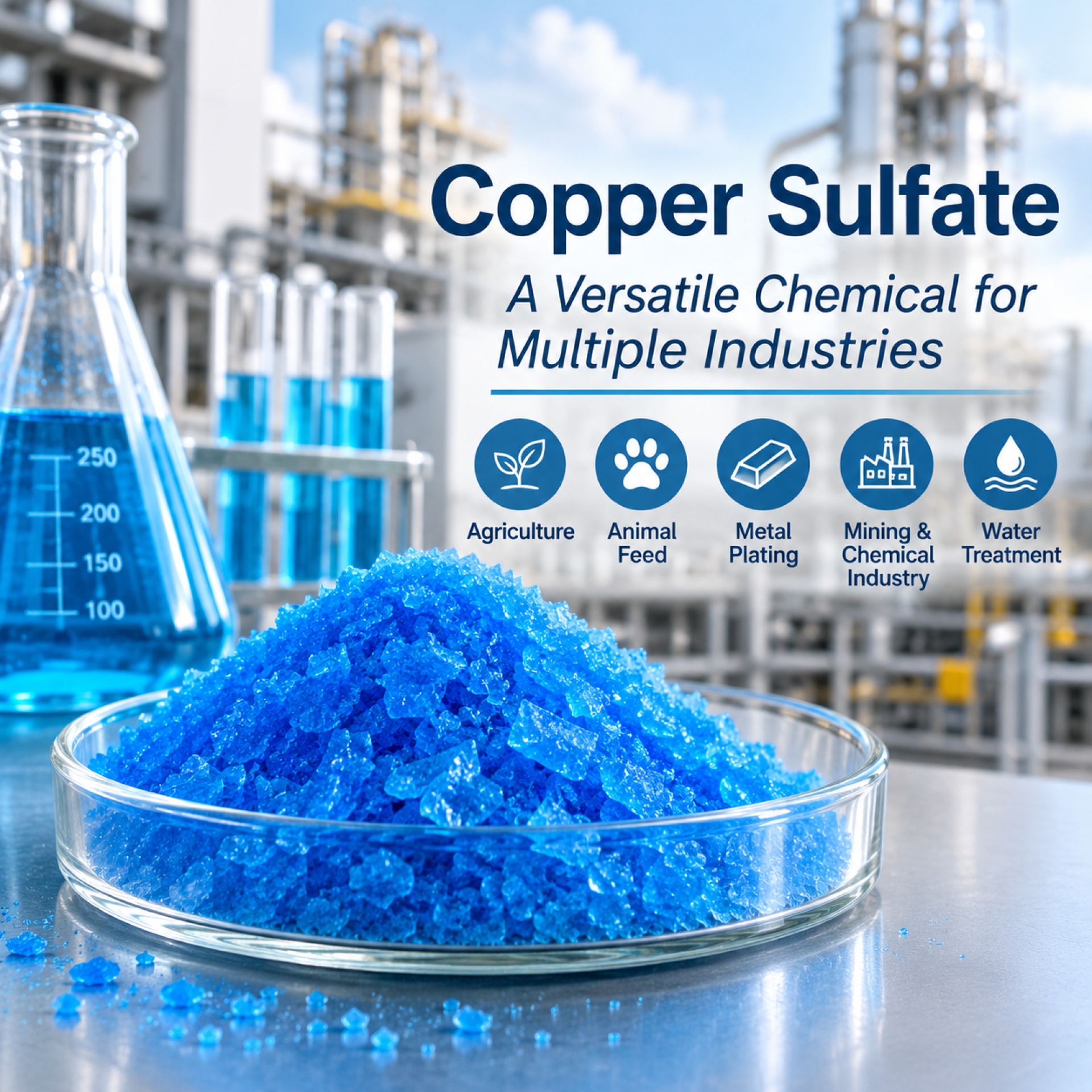
Copper sulfate is an important inorganic chemical widely used across various industrial sectors. Known for its distinctive blue crystalline appearance in its pentahydrate form, this compound offers valuable chemical properties that support manufacturing processes, mineral processing, agricultural production, and water management.
Understanding Copper Sulfate Uses in Industry helps manufacturers and industrial buyers identify suitable applications, select the right product grade, and improve process efficiency. From metal finishing to chemical manufacturing, copper sulfate plays a significant role in applications where copper ions and specific chemical reactions are required.
In this article, we explore the major Industrial Applications of Copper Sulfate, its key benefits, and the factors businesses should consider when sourcing this versatile industrial chemical.
What Is Copper Sulfate?
Copper sulfate is an inorganic compound with the chemical formula CuSO₄. It is available in different forms, including anhydrous copper sulfate and copper sulfate pentahydrate (CuSO₄·5H₂O).
Anhydrous copper sulfate contains no water of crystallization, while copper sulfate pentahydrate contains five water molecules within its crystalline structure. The pentahydrate form is commonly recognized by its bright blue crystals and is widely used in industrial and commercial applications.
Key characteristics of copper sulfate include:
- Chemical composition: Contains copper and sulfate ions.
- Solubility: Copper sulfate pentahydrate dissolves readily in water.
- Versatility: Suitable for various chemical processes, depending on product grade and application requirements.
- Commercial availability: Supplied in different specifications to meet industrial needs.
The appropriate form and grade depend on the intended application, required purity, handling conditions, and applicable industry standards.
1.Copper Sulfate in Mining and Mineral Processing
One of the significant Copper Sulfate Applications is in the mining industry, particularly in mineral processing and flotation operations.
Froth flotation is a separation technique used to recover valuable minerals from ore. In certain mineral processing systems, copper sulfate is used as an activator to improve the flotation response of specific minerals.
Its role depends on the mineral composition, process chemistry, and flotation conditions. By supporting the separation of target minerals from unwanted materials, copper sulfate can contribute to more effective mineral recovery when properly applied.
Common considerations for mining applications include:
- Ore composition and mineral characteristics
- Water chemistry and process conditions
- Dosage requirements and reagent compatibility
- Desired mineral recovery and concentrate quality
Industrial operators should evaluate copper sulfate performance through laboratory testing and process trials before implementing changes to a full-scale operation.
2. Copper Sulfate in Electroplating and Metal Finishing
Electroplating is another important application of copper sulfate, particularly in the production of copper coatings on metal surfaces.
In copper electroplating baths, copper sulfate provides copper ions that are deposited onto a conductive surface through an electrical process. The resulting copper layer can improve electrical conductivity and provide a suitable surface for subsequent manufacturing steps.
Applications include printed circuit board production, electronic components, and selected metal-finishing processes.
The performance of an electroplating bath depends on several factors, including copper sulfate concentration, electrolyte composition, operating temperature, current density, and bath maintenance.
For industrial manufacturers, consistent chemical quality is important for maintaining process stability and achieving the desired coating characteristics. Product specifications should therefore be matched to the requirements of the electroplating system.
3.Copper Sulfate in Agriculture
Agriculture is a well-established area of copper sulfate use. Copper is an essential micronutrient required for normal plant growth, although plants need it only in relatively small quantities.
Copper sulfate may be used in the preparation of agricultural formulations, including products designed to address copper deficiencies in suitable crops and soils. It is also used in certain plant protection formulations where permitted by applicable regulations.
The benefits depend on the crop, soil conditions, formulation, and application method.
Important considerations include:
- Assessing whether copper supplementation is necessary
- Following recommended application rates
- Avoiding excessive copper accumulation in soil
- Complying with local agricultural and environmental regulations
Because excessive copper can harm plants and aquatic organisms, copper sulfate should be used according to the relevant product label and professional recommendations.
4.Copper Sulfate in Water Treatment
Water management is another area in which copper sulfate may have a role. Certain formulations are used to control algae in selected water systems, subject to local regulations and site-specific conditions.
Copper sulfate is not a universal solution for water treatment. Its suitability depends on water chemistry, the organisms being controlled, the intended water use, and environmental requirements.
Before selecting copper sulfate for an application, operators should evaluate:
- Water quality and chemical composition
- Potential effects on aquatic organisms
- Discharge requirements and environmental restrictions
- Applicable regulations and permitted treatment methods
For industrial facilities, chemical selection should be based on treatment objectives, compatibility with the existing system, and an assessment of potential environmental impacts.
Where copper-containing chemicals are used, appropriate monitoring and wastewater management are essential to prevent unacceptable copper concentrations in discharged water.
5.Copper Sulfate in Chemical Manufacturing
Copper sulfate is also used as a raw material and chemical reagent in selected manufacturing processes.
Its chemical composition makes it useful in preparing copper-containing compounds and formulations. Depending on the process, it may serve as a source of copper ions or participate in reactions that produce other chemical substances.
Potential applications include the preparation of specialty chemicals, laboratory reagents, and selected industrial formulations.
Manufacturers should consider the required purity, moisture content, physical form, and impurity limits when choosing copper sulfate for chemical production.
Selecting an appropriate grade helps support product consistency and reduces the risk of unwanted impurities affecting downstream processes.
6.Copper Sulfate in Wood Preservation and Other Applications
Copper sulfate has also been used in certain wood-treatment formulations and other specialized applications involving copper compounds.
Its suitability depends on the formulation, intended function, treatment method, and applicable product regulations. Not every copper sulfate grade is suitable for every application, and additional formulation components may be required to achieve the desired performance.
Industrial buyers should confirm that the selected product meets the relevant technical specifications and regulatory requirements before use.
Key Benefits of Copper Sulfate for Industrial Use
The wide range of Copper Sulfate Uses reflects its versatility as a source of copper in different chemical and manufacturing processes.
Its key advantages include:
1.Versatile industrial applications
Copper sulfate can support several sectors, including mining, electroplating, agriculture, and chemical manufacturing.
2.Availability in different forms
Anhydrous copper sulfate and copper sulfate pentahydrate offer different characteristics, allowing buyers to select a suitable form for their processes.
3.Compatibility with established processes
When the correct grade is selected, copper sulfate can be incorporated into suitable existing industrial systems.
4.Flexible sourcing options
Industrial buyers can evaluate product specifications, packaging, and supply arrangements according to their operational requirements.
However, the benefits achieved depend on the application, product quality, dosage, and operating conditions. Technical evaluation remains essential before commercial implementation.
How to Choose the Right Copper Sulfate Supplier
Selecting a reliable supplier is an important part of effective chemical procurement. Industrial buyers should evaluate more than price alone, particularly when product consistency can influence production quality and operating performance.
Consider the following factors when sourcing copper sulfate:
- Product specifications: Confirm the chemical form, purity, and relevant technical requirements.
- Quality documentation: Request a Certificate of Analysis (COA) and a Safety Data Sheet (SDS) where applicable.
- Application suitability: Ensure the selected grade meets the requirements of the intended process.
- Supply reliability: Evaluate product availability, packaging options, delivery schedules, and order requirements.
- Safety and compliance: Confirm appropriate handling, storage, transportation, and regulatory documentation.
Working with a supplier that understands industrial chemical requirements can help businesses make informed purchasing decisions and maintain more consistent operations.
Conclusion
Copper sulfate is a versatile inorganic chemical with applications across mining, electroplating, agriculture, water management, chemical manufacturing, and selected specialized industries.
Understanding Copper Sulfate Uses in Industry enables businesses to assess where this compound may support their processes and what specifications are necessary for effective use. The correct product form, consistent quality, and compliance with relevant technical and environmental requirements are essential considerations.
For industrial buyers, choosing an appropriate copper sulfate grade and a dependable supply partner can support product quality, operational efficiency, and long-term procurement planning.
Unching Industry provides industrial chemical solutions to support the needs of businesses across different sectors. Contact our team to discuss your chemical requirements and identify suitable products for your industrial applications.
Frequently Asked Questions (FAQs)
1.What is copper sulfate mainly used for in industry?
Copper sulfate is used in applications such as mineral processing, copper electroplating, chemical manufacturing, selected water treatment processes, and agricultural formulations.
2.What is the difference between copper sulfate and copper sulfate pentahydrate?
Copper sulfate refers to the compound CuSO₄, while copper sulfate pentahydrate (CuSO₄·5H₂O) contains five water molecules in its crystalline structure. Their physical properties and suitability for particular processes differ.
3.Is copper sulfate soluble in water?
Yes. Copper sulfate pentahydrate is soluble in water, making it suitable for applications that require a dissolved source of copper ions. Solubility and handling requirements should be evaluated for the intended process.
4.How do I select copper sulfate for industrial use?
Consider the intended application, chemical form, purity, product specifications, documentation, and supplier reliability. Consult the relevant technical documentation before selecting a grade.