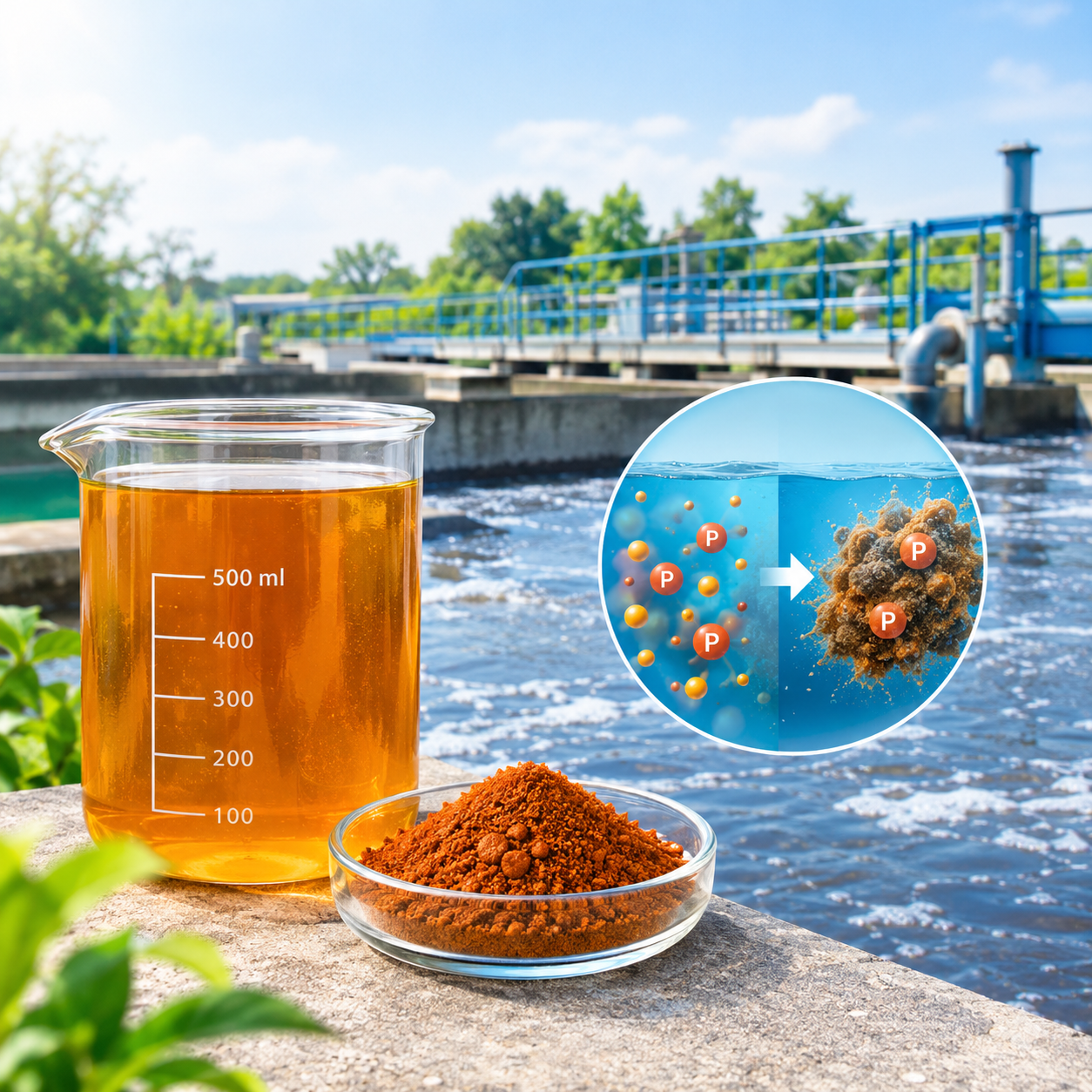
Ferric Chloride for Phosphorus Removal in Wastewater
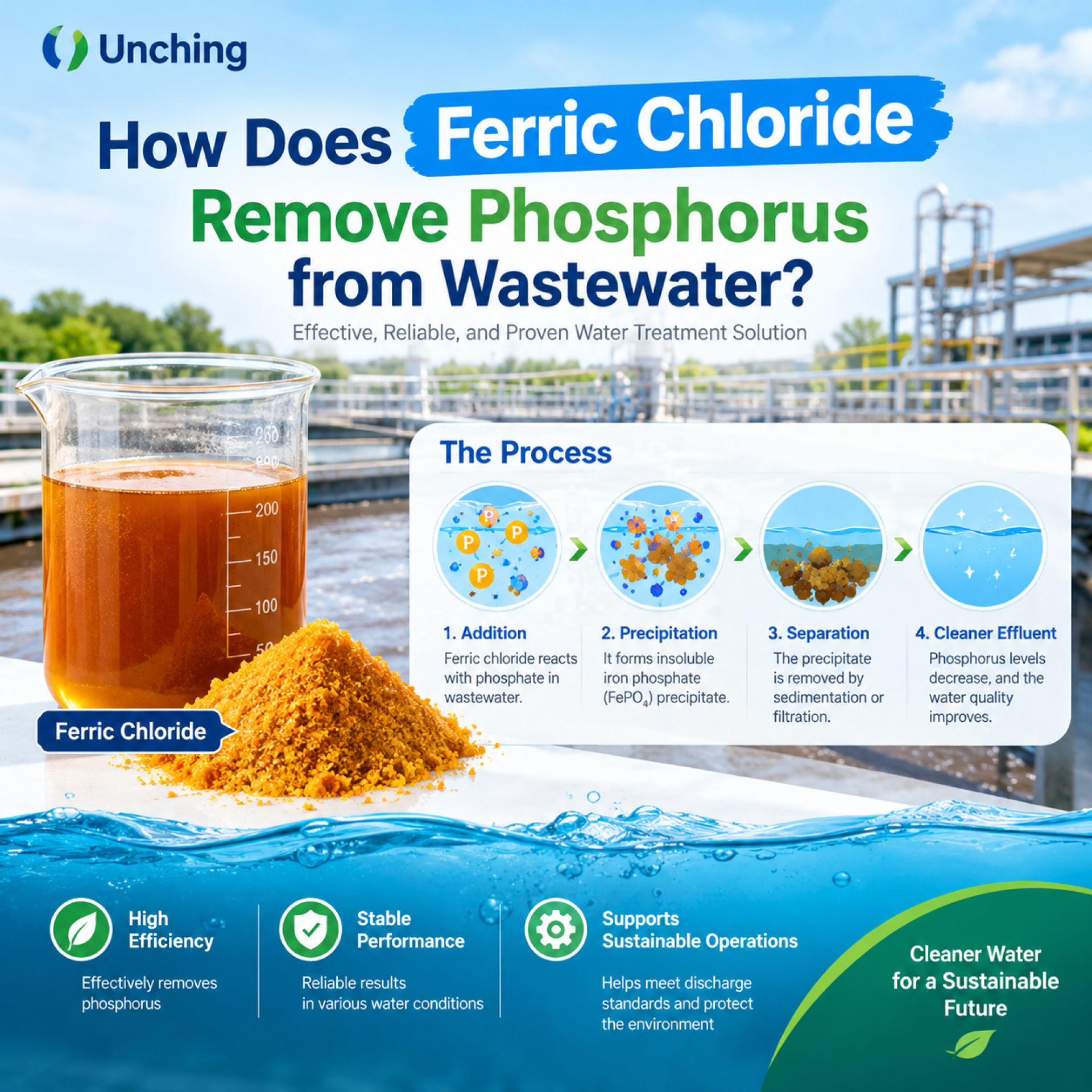
How Does Ferric Chloride for Phosphorus Removal in Wastewater?
Phosphorus is a common component of industrial wastewater generated by various manufacturing processes. When discharged in excessive amounts, phosphorus can contribute to eutrophication, excessive algae growth, and deterioration of aquatic ecosystems. Effective phosphorus control is therefore an important part of industrial wastewater treatment and environmental management.
Ferric chloride phosphorus removal is a widely used chemical treatment approach that helps reduce phosphate concentrations in wastewater through chemical precipitation. When applied under suitable operating conditions, ferric chloride can support phosphorus removal, improve solids separation, and help industrial facilities achieve their wastewater treatment objectives.
In this article, Unching Industry explains how ferric chloride works, the factors affecting treatment performance, and how to optimize its application in industrial wastewater treatment systems.
1. What Is Ferric Chloride?
Ferric chloride, also known as iron(III) chloride, is an inorganic chemical compound with the chemical formula FeCl₃. It is used in various industrial applications, including water and wastewater treatment.
In wastewater treatment, ferric chloride provides ferric ions (Fe³⁺), which react with phosphate under suitable conditions to form iron phosphate precipitates. Ferric hydroxide may also form during the treatment process, helping capture suspended particles and supporting coagulation.
These properties make ferric chloride a useful option for facilities seeking to reduce phosphorus concentrations and improve wastewater treatment performance.
2. How Does Ferric Chloride Remove Phosphorus from Wastewater?
The process of phosphorus removal from wastewater using ferric chloride primarily involves chemical precipitation, followed by the separation of the resulting solids.
Step 1: Chemical Reaction with Phosphate
When ferric chloride is added to wastewater, ferric ions can react with phosphate to form sparingly soluble iron phosphate compounds.
A simplified reaction is:
Fe³⁺ + PO₄³⁻ → FePO₄(s)
This equation illustrates the basic precipitation mechanism. In actual wastewater, phosphate exists in different forms depending on pH, and the reactions can be more complex.
Step 2: Coagulation and Particle Aggregation
Ferric chloride can also promote coagulation by destabilizing colloidal particles. Depending on the water chemistry, iron hydroxide precipitates may form and help capture fine suspended solids.
This process encourages particles to aggregate into larger flocs, making them easier to separate from the treated water.
Step 3: Sedimentation and Solids Separation
After chemical reactions and floc formation, the wastewater passes through sedimentation or another suitable solids separation process. The resulting sludge contains precipitated phosphorus and other captured solids.
The overall treatment efficiency depends not only on the chemical reaction but also on mixing conditions, pH control, settling performance, and the effectiveness of the separation equipment.
3. Key Benefits of Ferric Chloride for Wastewater Treatment
Ferric chloride can provide several operational benefits when selected and applied appropriately.
- Effective phosphorus reduction: Helps reduce phosphate concentrations through chemical precipitation.
- Improved coagulation: Can promote the aggregation of suspended particles and colloids.
- Flexible application: May be applied at different stages of a treatment system, depending on process design.
- Support for discharge compliance: Can help facilities meet phosphorus-related wastewater requirements when the overall treatment process is properly designed and operated.
- Potential process optimization: Appropriate dosing and operating control can improve treatment performance and help manage chemical consumption.
Actual results depend on wastewater composition, phosphate concentration, pH, chemical dosage, and solids separation performance. Testing is recommended before full-scale implementation.
4. Factors Affecting Ferric Chloride Phosphorus
Removal
To achieve consistent treatment performance, industrial facilities should evaluate several important operating factors.
4.1 Wastewater pH
pH influences iron speciation, precipitation reactions, and coagulation performance. If the pH is outside the suitable operating range, phosphorus removal and floc formation may become less effective.
Facilities should evaluate pH conditions during laboratory testing and monitor them during operation.
4.2 Initial Phosphorus Concentration
Wastewater with different initial phosphorus concentrations may require different chemical dosages and treatment conditions. Measuring influent and effluent phosphorus helps operators assess removal efficiency and adjust the treatment process.
4.3 Ferric Chloride Dosage
Ferric chloride dosage for phosphorus removal must be determined based on wastewater characteristics and the required treatment target.
Insufficient dosage may result in incomplete phosphorus removal, while excessive dosage can increase chemical costs, sludge production, and the potential need for pH adjustment. A controlled jar test is an effective way to evaluate suitable dosage ranges before full-scale use.
4.4 Mixing and Reaction Time
Appropriate rapid mixing helps distribute the chemical throughout the wastewater. Subsequent flocculation and sufficient settling time support the formation and separation of precipitated solids.
Poor mixing or inadequate settling may reduce overall treatment performance, even when the chemical itself is suitable.
4.5 Other Wastewater Constituents
Suspended solids, organic matter, alkalinity, and other dissolved substances may affect chemical demand and precipitation behavior. A complete wastewater analysis is therefore important when developing a reliable treatment strategy.
5. How to Optimize Ferric Chloride Dosage for Phosphorus Removal
Optimizing chemical dosage helps balance treatment performance, operating cost, and sludge management requirements.
The following approach can help industrial facilities establish an appropriate operating strategy:
1.Analyze wastewater quality. Measure phosphorus or phosphate concentration, pH, suspended solids, and other relevant parameters.
2.Define the treatment target. Identify the required effluent quality and applicable discharge limits.
3.Conduct a jar test. Compare different ferric chloride dosages under controlled mixing, reaction, and settling conditions.
4.Evaluate treatment performance. Measure residual phosphorus and review floc formation, settling behavior, and sludge characteristics.
5.Assess operating costs. Consider chemical consumption, pH adjustment, sludge handling, and related process expenses.
6.Validate under operating conditions. Confirm laboratory findings through controlled implementation and ongoing monitoring.
The optimum dosage is specific to the wastewater and treatment system. It should be established through testing rather than relying on a universal dosage value.
6. Ferric Chloride Precipitation vs. Other Phosphorus Removal Methods
Chemical phosphorus removal is one of several approaches available for wastewater treatment. The most suitable method depends on the phosphorus concentration, wastewater characteristics, treatment objectives, and existing process design.
Ferric chloride precipitation is commonly evaluated when chemical removal is required. Other options may include alternative metal-based coagulants, biological phosphorus removal, or combinations of chemical and biological treatment.
| Treatment approach | Main consideration |
| Ferric chloride precipitation | Chemical reaction with phosphate and subsequent solids separation |
| Other chemical precipitation methods | Performance depends on the chemical used and wastewater conditions |
| Biological phosphorus removal | Requires suitable biological process conditions and operational control |
| Combined treatment | May be considered when wastewater characteristics or discharge targets require multiple treatment stages |
A site-specific assessment helps determine whether ferric chloride alone or a combined treatment strategy is most appropriate.
7. Industrial Applications of Ferric Chloride
Ferric chloride may be considered for phosphorus control in industrial wastewater systems where phosphate removal is required. Potential applications depend on the wastewater source and process conditions.
Examples include manufacturing facilities with phosphorus-containing process streams, industrial wastewater plants requiring chemical phosphorus removal, and treatment systems where coagulation and solids separation are part of the overall process.
Before implementation, facilities should confirm product specifications, chemical compatibility, dosing equipment requirements, and the performance of the proposed treatment method through appropriate testing.
8. Safety and Handling Considerations
Ferric chloride is a corrosive chemical and must be handled according to its Safety Data Sheet (SDS) and applicable site safety procedures.- Industrial facilities should:
- Use suitable personal protective equipment.
- Select compatible storage tanks, pipes, pumps, and dosing equipment.
- Follow appropriate procedures for chemical storage, dilution, and handling.
- Monitor pH and treatment conditions during operation.
- Establish spill response and emergency procedures.
- Train personnel in safe chemical handling practices.
Proper handling and equipment selection help protect workers, maintain system reliability, and reduce operational risks.
9. Choosing Ferric Chloride for Industrial Wastewater Treatment
Selecting a suitable ferric chloride product requires more than comparing purchase prices. Facilities should evaluate product specifications, wastewater characteristics, treatment targets, dosage requirements, and the total cost of operation.
A well-designed treatment strategy should consider phosphorus removal performance, sludge generation, equipment compatibility, and ongoing monitoring requirements.
Unching Industry provides industrial chemical solutions to support customers' application needs. For facilities evaluating ferric chloride for phosphorus removal or other wastewater treatment applications, reviewing product information and conducting appropriate performance testing are important steps toward selecting a suitable solution.
Contact Unching Industry to learn more about ferric chloride and industrial wastewater treatment chemical solutions for your facility.
Frequently Asked Questions (FAQ)
1. How does ferric chloride remove phosphorus from wastewater?
Ferric chloride releases ferric ions that react with phosphate to form sparingly soluble iron phosphate compounds. The precipitated solids can then be removed through sedimentation or another suitable separation process.
2. Is ferric chloride effective for phosphate removal?
Ferric chloride can be effective for phosphate removal when the wastewater chemistry, pH, dosage, and solids separation conditions are appropriate. Actual performance should be confirmed through testing.
3. What affects ferric chloride phosphorus removal efficiency?
Important factors include pH, initial phosphate concentration, ferric chloride dosage, mixing conditions, reaction time, and sedimentation performance.
4. How is ferric chloride dosage determined?
Dosage is typically established through wastewater analysis and jar testing. The selected dosage should achieve the required treatment performance while considering chemical consumption and sludge management costs.
5. Does ferric chloride increase sludge production?
Yes. Chemical precipitation and the formation of iron hydroxide solids can increase sludge production. Sludge volume and handling requirements should be considered when evaluating the overall treatment cost.
6. Can ferric chloride be used in industrial wastewater treatment systems?
Yes. It may be used in industrial wastewater systems where chemical coagulation or phosphorus removal is required, provided the product and treatment conditions are suitable for the specific wastewater.
Conclusion
Ferric chloride phosphorus removal is an established chemical approach for reducing phosphate concentrations in wastewater. By promoting iron phosphate precipitation and supporting coagulation, ferric chloride can contribute to effective industrial wastewater treatment when operating conditions are properly controlled.
For reliable results, facilities should evaluate wastewater quality, determine suitable dosage through jar testing, monitor pH, and ensure effective solids separation. A well-planned chemical treatment strategy can help improve process performance and support wastewater management objectives.
Contact Unching Industry for information about ferric chloride and industrial wastewater treatment chemical solutions tailored to your application.