4 Types of Industrial Wastewater Treatment Systems
Last updated: 5 Sept 2026
93 Views
4 Types of Industrial Wastewater Treatment Systems
Industrial wastewater management is an essential part of modern manufacturing. Different industries generate wastewater with different characteristics, including suspended solids, organic matter, oils, chemicals, nutrients, color, and other contaminants. Without appropriate treatment, these pollutants can affect water quality, the environment, and overall operational sustainability.
So, how many types of industrial wastewater treatment systems are there?
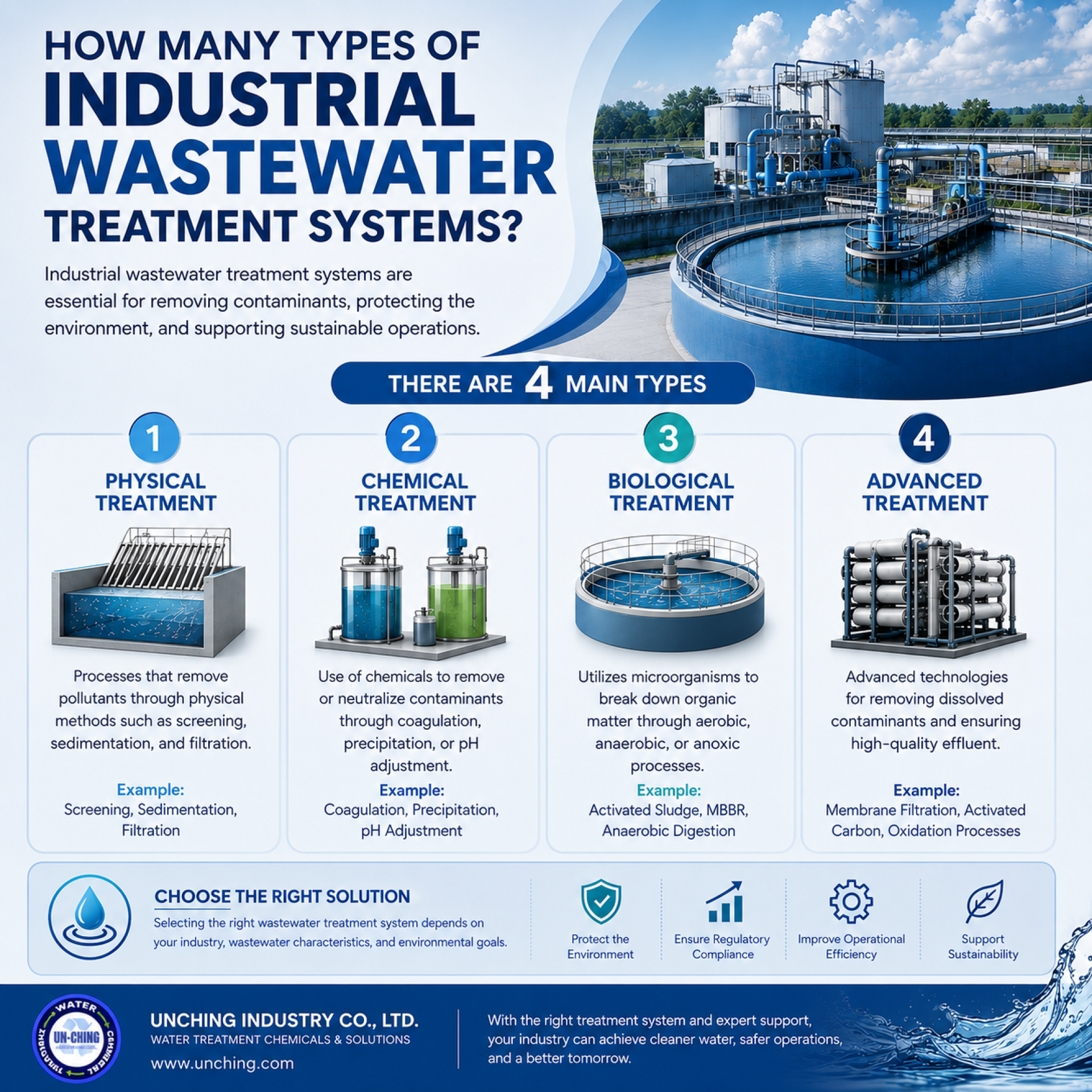
In general, industrial wastewater treatment can be understood through four major treatment categories:
1. Physical Wastewater Treatment
2. Chemical Wastewater Treatment
3. Biological Wastewater Treatment
4. Advanced Wastewater Treatment
In practice, an Industrial Wastewater Treatment System may combine several of these processes to achieve the required water quality. The right combination depends on wastewater characteristics, production processes, treatment objectives, discharge requirements, operating costs, and opportunities for water reuse.
What Is an Industrial Wastewater Treatment System?
An Industrial Wastewater Treatment System is a combination of processes and technologies designed to remove or reduce contaminants from wastewater generated by industrial activities.
Unlike domestic wastewater, industrial wastewater can vary significantly depending on the manufacturing process. Food and beverage plants, chemical manufacturers, textile factories, metal finishing facilities, paper mills, and other industries may produce wastewater with very different pollutant profiles.
An effective Industrial Wastewater Treatment Process therefore begins with understanding the wastewater itself.
Typical parameters that may need to be evaluated include:
The 4 Main Types of Industrial Wastewater Treatment
1. Physical Wastewater Treatment
Physical Wastewater Treatment uses physical processes to separate contaminants from wastewater without primarily relying on chemical reactions or biological activity.
It is often used as an initial stage of an Industrial Wastewater Treatment Plant to remove larger particles and reduce the load on downstream treatment processes.
Common Physical Treatment Processes
Screening
Removes large solids such as plastics, fibers, packaging materials, food particles, and other debris.
Grit Removal
Separates heavier inorganic particles such as sand and grit.
Sedimentation
Allows suspended solids to settle by gravity.
Filtration
Uses filter media or filtration equipment to remove remaining suspended particles.
Oil and Grease Separation
Separates floating oils and grease from wastewater where applicable.
Physical treatment can be particularly valuable as a pretreatment step because removing solids early can improve the stability and efficiency of subsequent chemical or biological processes.
Examples
2. Chemical Wastewater Treatment
Chemical Wastewater Treatment uses chemical reactions to destabilize, neutralize, precipitate, oxidize, or otherwise transform contaminants so that they can be separated from wastewater.
Chemical treatment is especially important when wastewater contains contaminants that cannot be effectively removed through physical processes alone.
Coagulation and Flocculation
One of the most common applications is Coagulation and Flocculation.
Coagulants are added to wastewater to destabilize fine particles and colloids. Flocculation then promotes the formation of larger aggregates, or flocs, which can be removed through sedimentation or filtration.
Common Coagulants for Wastewater Treatment include:
The selection of a suitable coagulant depends on wastewater characteristics and operating conditions. In many applications, laboratory testing such as a jar test can help determine the appropriate chemical and dosage.
Other Chemical Treatment Applications
Chemical treatment may also include:
pH adjustment
Chemical precipitation
Phosphorus removal
Heavy metal precipitation
Oxidation processes
Neutralization
For this reason, Wastewater Treatment Chemicals play an important role in many industrial treatment systems.
3. Biological Wastewater Treatment
Biological Wastewater Treatment uses microorganisms to break down biodegradable organic matter in wastewater.
It is particularly important for industrial wastewater containing significant concentrations of biodegradable organic compounds. Biological processes can help reduce parameters such as BOD and, depending on the process and operating conditions, COD.
Activated Sludge
Activated Sludge is one of the most widely recognized biological treatment processes. Microorganisms are maintained in suspension and supplied with oxygen to support biological activity.
MBBR
MBBR (Moving Bed Biofilm Reactor) uses specialized media that provide surfaces for microorganisms to grow as biofilms.
MBBR technology can offer flexibility when upgrading existing systems or when additional biological treatment capacity is required.
SBR
SBR (Sequencing Batch Reactor) performs several treatment stages within the same reactor, typically following a controlled sequence such as filling, biological reaction, settling, and decanting.
Anaerobic Treatment
Anaerobic processes use microorganisms under oxygen-free conditions and can be suitable for certain high-strength industrial wastewater applications.
The selection of a Biological Wastewater Treatment process depends on factors such as organic loading, wastewater biodegradability, flow rate, temperature, available space, and desired effluent quality.
4. Advanced Wastewater Treatment
Advanced Wastewater Treatment is used when conventional physical, chemical, and biological processes do not achieve the required water quality or when specific contaminants need to be removed.
Advanced treatment can be particularly important for industrial facilities seeking higher-quality effluent or opportunities for water reuse.
Common Advanced Treatment Technologies
Membrane Filtration
Membrane technologies can provide high levels of separation for suspended solids, microorganisms, dissolved substances, and other contaminants depending on the membrane type.
Common membrane processes include:
Microfiltration (MF)
Ultrafiltration (UF)
Nanofiltration (NF)
Reverse Osmosis (RO)
Activated Carbon
Activated carbon can be used to adsorb certain dissolved organic compounds, color, odors, and other contaminants depending on the wastewater characteristics.
Advanced Oxidation Processes
Advanced oxidation technologies can be considered for specific difficult-to-treat organic contaminants and applications requiring additional treatment beyond conventional processes.
Advanced treatment should be selected based on the required water quality, contaminant profile, operational requirements, and overall lifecycle cost.
Industrial wastewater management is an essential part of modern manufacturing. Different industries generate wastewater with different characteristics, including suspended solids, organic matter, oils, chemicals, nutrients, color, and other contaminants. Without appropriate treatment, these pollutants can affect water quality, the environment, and overall operational sustainability.
So, how many types of industrial wastewater treatment systems are there?
In general, industrial wastewater treatment can be understood through four major treatment categories:
1. Physical Wastewater Treatment
2. Chemical Wastewater Treatment
3. Biological Wastewater Treatment
4. Advanced Wastewater Treatment
In practice, an Industrial Wastewater Treatment System may combine several of these processes to achieve the required water quality. The right combination depends on wastewater characteristics, production processes, treatment objectives, discharge requirements, operating costs, and opportunities for water reuse.
What Is an Industrial Wastewater Treatment System?
An Industrial Wastewater Treatment System is a combination of processes and technologies designed to remove or reduce contaminants from wastewater generated by industrial activities.
Unlike domestic wastewater, industrial wastewater can vary significantly depending on the manufacturing process. Food and beverage plants, chemical manufacturers, textile factories, metal finishing facilities, paper mills, and other industries may produce wastewater with very different pollutant profiles.
An effective Industrial Wastewater Treatment Process therefore begins with understanding the wastewater itself.
Typical parameters that may need to be evaluated include:
- pH
- BOD
- COD
- TSS
- Turbidity
- Oil and grease
- Nitrogen
- Phosphorus
- Color
- Heavy metals
- Specific chemicals or industrial contaminants
The 4 Main Types of Industrial Wastewater Treatment
1. Physical Wastewater Treatment
Physical Wastewater Treatment uses physical processes to separate contaminants from wastewater without primarily relying on chemical reactions or biological activity.
It is often used as an initial stage of an Industrial Wastewater Treatment Plant to remove larger particles and reduce the load on downstream treatment processes.
Common Physical Treatment Processes
Screening
Removes large solids such as plastics, fibers, packaging materials, food particles, and other debris.
Grit Removal
Separates heavier inorganic particles such as sand and grit.
Sedimentation
Allows suspended solids to settle by gravity.
Filtration
Uses filter media or filtration equipment to remove remaining suspended particles.
Oil and Grease Separation
Separates floating oils and grease from wastewater where applicable.
Physical treatment can be particularly valuable as a pretreatment step because removing solids early can improve the stability and efficiency of subsequent chemical or biological processes.
Examples
- Screening
- Sedimentation
- Clarification
- Filtration
- Oil separation
2. Chemical Wastewater Treatment
Chemical Wastewater Treatment uses chemical reactions to destabilize, neutralize, precipitate, oxidize, or otherwise transform contaminants so that they can be separated from wastewater.
Chemical treatment is especially important when wastewater contains contaminants that cannot be effectively removed through physical processes alone.
Coagulation and Flocculation
One of the most common applications is Coagulation and Flocculation.
Coagulants are added to wastewater to destabilize fine particles and colloids. Flocculation then promotes the formation of larger aggregates, or flocs, which can be removed through sedimentation or filtration.
Common Coagulants for Wastewater Treatment include:
- Poly Aluminium Chloride (PAC)
- Ferric Chloride
- Aluminium-based coagulants
- Polymers used as flocculant aids
The selection of a suitable coagulant depends on wastewater characteristics and operating conditions. In many applications, laboratory testing such as a jar test can help determine the appropriate chemical and dosage.
Other Chemical Treatment Applications
Chemical treatment may also include:
pH adjustment
Chemical precipitation
Phosphorus removal
Heavy metal precipitation
Oxidation processes
Neutralization
For this reason, Wastewater Treatment Chemicals play an important role in many industrial treatment systems.
3. Biological Wastewater Treatment
Biological Wastewater Treatment uses microorganisms to break down biodegradable organic matter in wastewater.
It is particularly important for industrial wastewater containing significant concentrations of biodegradable organic compounds. Biological processes can help reduce parameters such as BOD and, depending on the process and operating conditions, COD.
Activated Sludge
Activated Sludge is one of the most widely recognized biological treatment processes. Microorganisms are maintained in suspension and supplied with oxygen to support biological activity.
MBBR
MBBR (Moving Bed Biofilm Reactor) uses specialized media that provide surfaces for microorganisms to grow as biofilms.
MBBR technology can offer flexibility when upgrading existing systems or when additional biological treatment capacity is required.
SBR
SBR (Sequencing Batch Reactor) performs several treatment stages within the same reactor, typically following a controlled sequence such as filling, biological reaction, settling, and decanting.
Anaerobic Treatment
Anaerobic processes use microorganisms under oxygen-free conditions and can be suitable for certain high-strength industrial wastewater applications.
The selection of a Biological Wastewater Treatment process depends on factors such as organic loading, wastewater biodegradability, flow rate, temperature, available space, and desired effluent quality.
4. Advanced Wastewater Treatment
Advanced Wastewater Treatment is used when conventional physical, chemical, and biological processes do not achieve the required water quality or when specific contaminants need to be removed.
Advanced treatment can be particularly important for industrial facilities seeking higher-quality effluent or opportunities for water reuse.
Common Advanced Treatment Technologies
Membrane Filtration
Membrane technologies can provide high levels of separation for suspended solids, microorganisms, dissolved substances, and other contaminants depending on the membrane type.
Common membrane processes include:
Microfiltration (MF)
Ultrafiltration (UF)
Nanofiltration (NF)
Reverse Osmosis (RO)
Activated Carbon
Activated carbon can be used to adsorb certain dissolved organic compounds, color, odors, and other contaminants depending on the wastewater characteristics.
Advanced Oxidation Processes
Advanced oxidation technologies can be considered for specific difficult-to-treat organic contaminants and applications requiring additional treatment beyond conventional processes.
Advanced treatment should be selected based on the required water quality, contaminant profile, operational requirements, and overall lifecycle cost.


Tags :