How Does Sedimentation Work in Wastewater Treatment?
Sedimentation Process: How It Works in Wastewater Treatment
Sedimentation is one of the fundamental processes used in modern water and wastewater treatment. By using gravity to separate suspended particles from water, the Sedimentation Process helps improve water quality, reduce suspended solids, and prepare wastewater for subsequent treatment stages.
In industrial applications, effective Sedimentation in Wastewater Treatment is particularly important because wastewater characteristics can vary significantly depending on the manufacturing process, raw materials, chemical usage, and production conditions.
A properly designed Sedimentation System can support efficient solid separation, improve treatment performance, and help maintain consistent effluent quality. When combined with appropriate Coagulation and Flocculation, sedimentation can provide an effective solution for removing suspended solids and separating sludge from treated water.
This article explains How Does Sedimentation Work, the role of a Sedimentation Tank, key factors affecting performance, and its applications in industrial wastewater treatment.
What Is Sedimentation?
Sedimentation is a physical treatment process that separates suspended solids and settleable particles from water by using gravity.
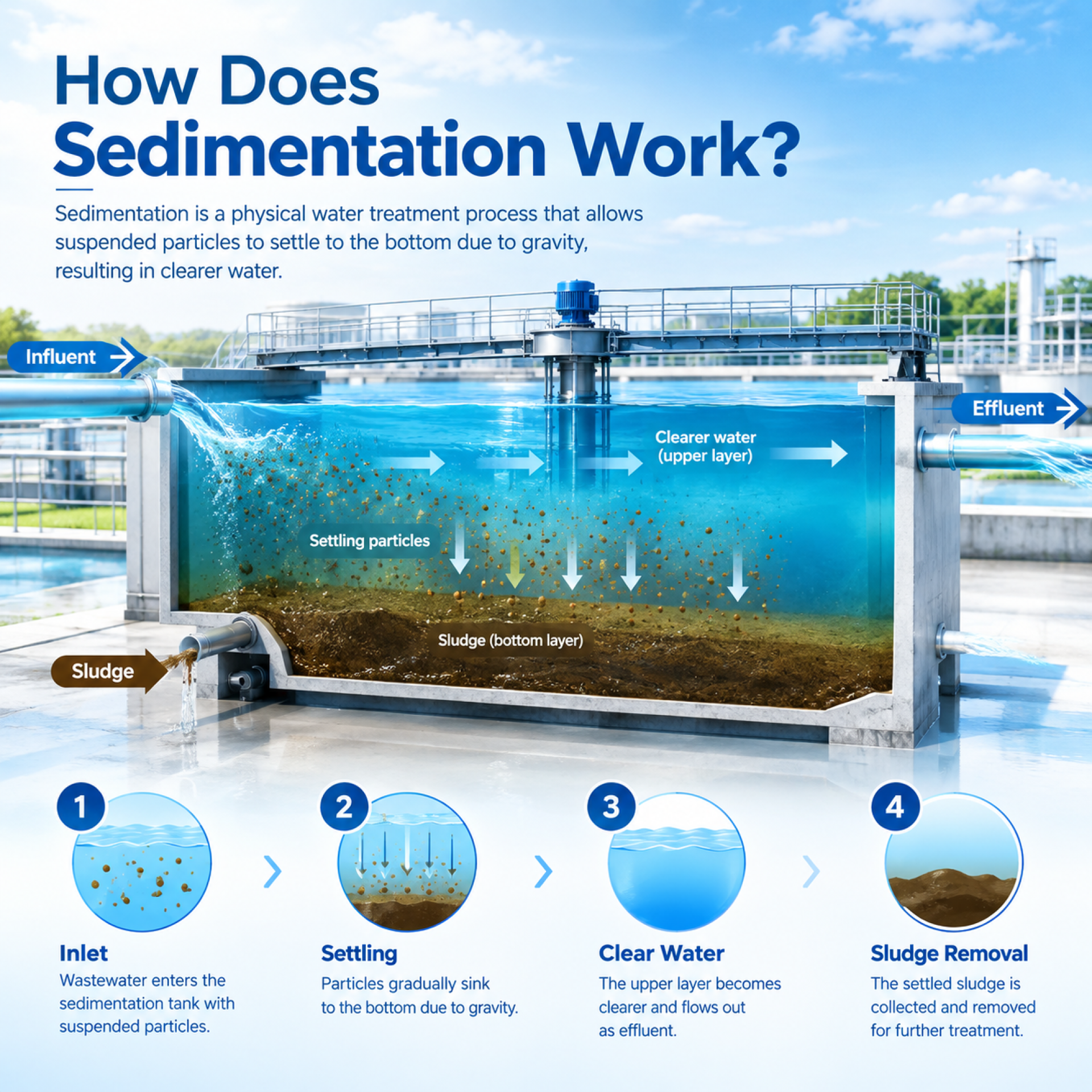
When wastewater enters a sedimentation tank, the flow velocity is controlled and reduced to create suitable settling conditions. Particles that are heavier than water gradually move downward and accumulate at the bottom of the tank, forming sludge. The relatively clear water remains in the upper portion and is collected for the next stage of treatment.
The basic principle is simple:
Wastewater → Reduced Flow Velocity → Particle Settling → Sludge Separation → Clarified Water
Because the process does not necessarily require complex mechanical treatment, sedimentation is widely applied in municipal water treatment, industrial wastewater treatment, and various water management systems.
How Does Sedimentation Work?
The Sedimentation Process relies primarily on gravity and controlled hydraulic conditions. Although the actual design can vary depending on the application, the process generally follows several important steps.
1. Wastewater Enters the Sedimentation Tank
Wastewater first enters the Sedimentation Tank through an inlet structure designed to distribute the flow evenly.
Proper inlet distribution is important because excessive turbulence can keep suspended particles in motion and reduce settling efficiency.
2. Water Flow Is Reduced
Inside the tank, the wastewater moves at a relatively low and controlled velocity.
The objective is to provide sufficient time and suitable hydraulic conditions for suspended particles to settle. If the flow is too fast, particles may remain suspended or become resuspended from the tank bottom.
3. Suspended Solids Settle by Gravity
As the wastewater moves through the settling zone, particles with sufficient density begin to settle toward the bottom.
Larger and heavier particles generally settle more rapidly, while smaller or lighter particles may require additional treatment to improve their settling characteristics.
4. Sludge Accumulates at the Bottom
Settled particles collect at the bottom of the tank and form sludge.
A sludge collection system may then transfer the accumulated material for further treatment, dewatering, disposal, or reuse, depending on the characteristics of the wastewater and the overall treatment system.
5. Clarified Water Flows Out
After suspended solids have settled, the clarified water moves toward the outlet section of the tank.
The treated water can then proceed to subsequent treatment stages such as biological treatment, filtration, membrane treatment, or other advanced processes.
This combination of Sludge Separation and Wastewater Clarification makes sedimentation an important part of many wastewater treatment systems.
What Is a Sedimentation Tank?
A Sedimentation Tank is a specially designed treatment unit that provides controlled conditions for suspended solids to settle by gravity.
Depending on the application, sedimentation tanks may have different shapes, dimensions, hydraulic configurations, and sludge collection mechanisms.
Common components include:
- Inlet distribution zone
- Settling zone
- Outlet or effluent collection zone
- Sludge collection area
- Sludge removal system
- Scum removal system, where required
The performance of a sedimentation tank depends not only on its physical design but also on wastewater characteristics, flow conditions, particle properties, and upstream treatment processes.
For industrial applications, tank design should therefore be evaluated according to the specific wastewater characteristics rather than using a one-size-fits-all approach.
Why Is Sedimentation Important in Wastewater Treatment?
Sedimentation plays an important role in Wastewater Treatment because it can remove a significant portion of settleable suspended solids before wastewater moves to subsequent treatment stages.
Suspended Solids Removal
One of the primary purposes of sedimentation is Suspended Solids Removal.
Reducing suspended solids can improve downstream treatment efficiency and reduce the solids loading placed on biological, filtration, or membrane processes.
Wastewater Clarification
Sedimentation helps produce clearer water by separating settleable particles from the liquid phase.
This clarification step can improve the overall appearance and quality of treated water while supporting subsequent treatment processes.
Sludge Separation
Settled solids are collected as sludge and can be directed to appropriate sludge treatment and management processes.
Effective sludge removal is important because excessive sludge accumulation can negatively affect tank performance.
Protection of Downstream Processes
Sedimentation can reduce the solids load entering downstream treatment units.
This can help protect equipment, improve process stability, and contribute to more consistent overall wastewater treatment performance.
Types of Sedimentation Treatment
Different types of Sedimentation Treatment can be used depending on the wastewater characteristics and treatment objectives.
Primary Sedimentation
Primary sedimentation is commonly used as an initial physical treatment stage.
Its main purpose is to remove readily settleable suspended solids and reduce the solids load entering subsequent biological treatment processes.
Secondary Sedimentation
Secondary sedimentation is commonly associated with biological wastewater treatment systems.
After biological treatment, a Clarifier can be used to separate biological solids from treated water. The settled biomass may then be returned to the biological process or removed as waste sludge.
Chemical Sedimentation
In some industrial wastewater applications, chemicals are used before sedimentation to improve particle removal.
Coagulants such as ferric chloride or polyaluminum chloride (PAC) can destabilize suspended particles and promote the formation of larger flocs.
These flocs can then settle more efficiently during the sedimentation stage.
Lamella Sedimentation
Lamella clarifiers use inclined plates or tubes to increase the effective settling area within a relatively compact footprint.
This approach can be useful where space is limited or where higher clarification capacity is required within a compact treatment system.
Sedimentation vs. Coagulation and Flocculation
Although these processes are closely related, they perform different functions.
Coagulation uses chemicals to destabilize suspended particles. Flocculation encourages these destabilized particles to combine into larger flocs. Sedimentation then allows the resulting particles or flocs to settle through gravity.
The overall process can therefore be represented as:
Coagulation → Flocculation → Sedimentation → Clarification
In industrial wastewater treatment, combining these processes appropriately can significantly improve Solid Separation in Wastewater Treatment.
However, chemical selection and dosage should be determined according to actual wastewater characteristics and treatment objectives.
Factors Affecting Sedimentation Efficiency
Several factors can influence the performance of a Sedimentation System.
Particle Size and Density
Particle size and density directly influence settling velocity. Larger and denser particles generally settle more readily than small or low-density particles.
Wastewater Flow Rate
Excessive flow rates can reduce settling efficiency by increasing turbulence and shortening the effective settling time.
Stable hydraulic conditions are therefore important for consistent performance.
Hydraulic Retention Time
Hydraulic retention time refers to the average time wastewater remains within the treatment unit.
Adequate retention time provides suspended particles with sufficient opportunity to settle.
Surface Overflow Rate
Surface overflow rate is an important design parameter used when evaluating sedimentation performance.
An appropriate rate helps ensure that particles with the desired settling characteristics can be effectively removed.
Sludge Accumulation
Excessive sludge accumulation can interfere with the settling process and potentially cause previously settled solids to become resuspended.
Regular sludge removal is therefore an important part of sedimentation system operation.
Chemical Dosing
For systems using chemical treatment, incorrect coagulant or flocculant dosage can negatively affect floc formation and settling performance.
Chemical optimization should be based on wastewater analysis and, where appropriate, jar testing or other process evaluations.
Industrial Wastewater Sedimentation Applications
Industrial Wastewater Sedimentation is used across a wide range of industries where suspended solids and settleable materials must be separated from wastewater.
Typical applications include:
- Manufacturing facilities
- Food and beverage processing
- Chemical manufacturing
- Mining and mineral processing
- Metal and surface treatment industries
- Pulp and paper production
- Industrial water reuse systems
- General wastewater treatment plants
Each industry can generate wastewater with different physical and chemical characteristics. As a result, the appropriate Sedimentation Treatment approach should be selected based on factors such as suspended solids concentration, particle characteristics, flow rate, pH, organic loading, and the presence of specific contaminants.
How to Improve Sedimentation Performance
A well-performing sedimentation system requires more than simply installing a tank. The entire treatment process should be evaluated as an integrated system.
Optimize Coagulation and Flocculation
When wastewater contains fine or colloidal particles that do not settle effectively, appropriate coagulation and flocculation can improve particle aggregation.
Selecting suitable Water Treatment Chemicals and optimizing their dosage can help produce stronger and more readily settleable flocs.
Maintain Stable Hydraulic Conditions
Avoiding excessive turbulence and uneven flow distribution can improve settling conditions within the tank.
Remove Sludge Regularly
Accumulated sludge should be removed according to the system's operating requirements to prevent excessive buildup and potential solids carryover.
Monitor Water Quality
Regular monitoring of parameters such as turbidity, suspended solids, pH, COD, BOD, and other relevant indicators can help identify changes in treatment performance.
Evaluate the Complete Treatment System
Sedimentation should not be considered independently from other treatment stages.
Upstream processes, chemical treatment, biological treatment, filtration, and sludge management can all influence the overall performance of the wastewater treatment system.
The Role of Sedimentation in an Industrial Wastewater Treatment System
In a complete Industrial Wastewater Treatment system, sedimentation may be used at different points depending on the treatment process.
A typical treatment sequence may include:
Screening → Equalization → Coagulation → Flocculation → Sedimentation → Biological Treatment → Filtration → Final Treatment
The actual configuration will vary depending on the industry, wastewater characteristics, discharge requirements, and desired treatment objectives.
A properly integrated Wastewater Treatment System can help improve operational reliability, treatment efficiency, and compliance with applicable effluent requirements.
Sedimentation and Sustainable Wastewater Management
Efficient sedimentation can contribute to more sustainable Wastewater Management by reducing the solids load entering downstream processes and supporting more efficient use of treatment resources.
When sedimentation, chemical treatment, biological treatment, and sludge management are properly integrated, industrial facilities can work toward more stable treatment performance and improved resource efficiency.
For industries facing increasingly stringent environmental requirements, selecting appropriate treatment technologies and maintaining effective process control are important elements of responsible environmental management.
Choosing the Right Sedimentation Solution
There is no single sedimentation design that is suitable for every industrial application.
The right solution depends on several factors, including:
- Wastewater flow rate
- Suspended solids concentration
- Particle size and characteristics
- Wastewater pH
- Chemical composition
- Required effluent quality
- Available installation area
- Sludge characteristics
- Existing treatment infrastructure
Chemical treatment may also play an important role where fine particles or colloidal solids are difficult to settle naturally. Selecting the right coagulant and flocculant can help improve the efficiency of the overall solid separation process.
Conclusion
The Sedimentation Process is a fundamental technology in water and wastewater treatment. By using gravity to separate suspended solids from water, sedimentation supports clarification, sludge separation, and overall treatment efficiency.
A properly designed Sedimentation Tank can provide effective solid separation when hydraulic conditions, particle characteristics, sludge management, and chemical treatment are appropriately controlled.
For industrial applications, sedimentation is often most effective when integrated with other treatment processes such as coagulation, flocculation, biological treatment, filtration, and advanced wastewater treatment.
Understanding How Does Sedimentation Work is therefore an important first step in developing an efficient and reliable wastewater treatment strategy.
Frequently Asked Questions About Sedimentation
1. What is sedimentation in wastewater treatment?
Sedimentation is a physical treatment process that uses gravity to separate suspended solids and settleable particles from wastewater.
2. How does the sedimentation process work?
Wastewater enters a sedimentation tank where flow velocity is reduced. Suspended particles settle toward the bottom through gravity, while clarified water flows toward the outlet.
3. What is a sedimentation tank used for?
A sedimentation tank is used to separate suspended solids from water or wastewater and produce clarified water for subsequent treatment stages.
4. What is the difference between sedimentation and coagulation?
Sedimentation primarily separates particles through gravity, while coagulation uses chemicals to destabilize suspended particles so they can form larger aggregates and settle more effectively.
5. What chemicals can improve sedimentation?
Coagulants such as ferric chloride and polyaluminum chloride (PAC) can improve particle aggregation. Flocculants may also be used to form larger and stronger flocs that settle more efficiently.
6. What factors affect sedimentation efficiency?
Important factors include particle size and density, wastewater flow rate, hydraulic retention time, surface overflow rate, sludge concentration, hydraulic conditions, and chemical dosing.
7. What is the role of sedimentation in industrial wastewater treatment?
Sedimentation helps remove suspended solids, reduce turbidity, separate sludge, and reduce the solids load entering downstream wastewater treatment processes.
8. How can sedimentation performance be improved?
Performance can be improved through appropriate tank design, stable hydraulic conditions, optimized coagulation and flocculation, suitable chemical dosing, regular sludge removal, and continuous water-quality monitoring.
Partner with Unching Industry for Water Treatment Solutions
At Unching Industry, we understand that every industrial wastewater application has unique treatment requirements.
With expertise in water treatment chemicals and industrial applications, we support customers in selecting appropriate solutions for effective Wastewater Treatment, solid separation, clarification, and process performance.
Whether you are optimizing an existing treatment system or developing a new wastewater treatment solution, choosing the right treatment approach can make an important difference to operational efficiency and environmental performance.
Contact Unching Industry to discuss your water and wastewater treatment requirements.
Unching Industry — Reliable Water Treatment Solutions for Sustainable Industrial Operations.